

Marriage structures and family policy
in the Mediterranean
Thaís GARCÍA PEREIRO
Roberta PACE
Università degli Studi di Bari “Aldo Moro”
Abstract : During the last decades western countries have witnessed remarkable socio-demographic changes in the family sphere: a definitive shift from extended to nuclear family forms, an intense decrease in nuptiality rates and a strong delay on its timing, an important increase in separation and divorce rates, and the emergence of new living arrangements such as unmarried cohabitation. These changes have raised considerable concern among policy makers. The main purpose of this study is to conduct a comparative analysis on nuptiality trends, marriage structures and family policies in five Mediterranean countries, namely, Italy, France, Spain, Portugal and Greece. This paper examines recent trends in marriage structures and family dynamics throughout Mediterranean Europe, discusses the context of those trends and considers public policy implications. Chronological and comparative analyses are based on the most recent available Eurostat and OECD data. These analyses shed some lights on countries’ commonalities and diversities, as observed in marriage patterns and family policies over time.
Keywords: Marriage, divorce, non marital births, family policies, Mediterranean.
1. INTRODUCTION
During the second half of the 20th century, the social institution of family has undergone relevant changes in most Western Societies. Family related behaviors and norms have been transformed pretty quickly and, as a consequence, the typical sequence of family transitions (getting marriage and having children) have been also transformed. Changing family formation patterns, characterized by an increasing number of divorces and separations, the emergence of non marital cohabitation and the late union formation, especially of marriage, suggest the existence of a South European model of demographic behaviors regarding family and couple issues.
Until a few decades ago, the universality of marriage was not in question. Throughout all Europe the way to start family life was via marriage, it was in this institution that children were raised and its stability was certain. Currently, marriage is neither the first nor the most preferred route of union or at least has lost much of its centrality: more children are born and rare outside its boundaries and lifelong marriage has been eroded over divorce[i].
These transformations are modifying the family system. The first change regards the level of family structures that are becoming increasingly complex (incomplete nuclear, single-parent and reconstituted families) and new forms of union (pre and post-marital cohabitation, Living Apart Together). The second concerns fertility dynamics, where important changes have been acted on reproductive projects, due to family instability, and in the nature of fertility, with the expansion of non marital births.
It is nowadays the norm for young adults living in Italy and Spain to delay union formation, postpone having children, get divorce and bare children outside marriage[ii] . The lowest-low fertility patterns, one of the most often cited demographic features of Southern European countries, is a result of the postponement of first union formation and childbearing[iii].
In France changes in marriage structures began forty years ago. Since the end of the 1960s marriage decline stimulated first the emergence and after 1980s the consolidation of alternative forms of union, which became progressively accepted. In France cohabitation grew constantly, compensating marriage decrease[iv].
In Portugal, instead, a significant proportion of young adults still show early marriage and parenthood patterns. According to das Dores Guerreiro and Abrantes[v] in 2001 the mother was less than 25 years old in 25% of total births and less than 25 in 43% of celebrated marriages. Traditionally in Portugal, a higher rate of cohabitation has been observed among the lower socio-economic groups. However, it is becoming mainstreaming as a pre-marital transitory phase among highly educated individuals[vi].
Following Tobío[vii] marriage structures in Greece have shown a diverse evolution of alternative forms of union due to the maintenance of high marriage rates.
The central purpose of this paper is to analyze transformations occurred in family formation processes in the Mediterranean during the last four decades. The study of the evolution of some family-related indicators (such as: mean age at first marriage, divorce rates and births outside marriage, among others) aims to highlight changes experienced by Mediterranean societies in such time period and to read these changes within a wider European context.
In order to compare family formation dynamics in Mediterranean Europe (Spain, Italy, Greece, France and Portugal) the paper is divided in five central sections. The first section identifies nuptiality trends, determining the evolution and timing of marriage patterns thorough the analysis of Crude Marriage Rates and Mean Age at Marriage for both females and males. The second section demonstrates the role of divorce and remarriage in these countries through the study of the evolution of Crude Divorce Rates and the number of second order marriages. The third section examines fertility patterns, focusing on the proportion of births outside marriage as a proxy indicator of cohabitation trends. Data presented in these sections is drawn from Eurostat and OECD data warehouses. Once examined the most characteristic features of marriage structures in the Mediterranean, the fourth section is dedicated to the analysis of family-related policies in Mediterranean Europe.
2. NUPTIALITY TRENDS
The empirical evidence of the last decades states several important changes occurred in contemporary union formation patterns. There are two main indicators that illustrate such changes: first, the decline in marriage rates and, second, the postponement of first marriages: people marry less and at older ages[viii].
The delay in the marriage timing began in Europe shortly after the time when marriage rates began to decline. Thanks to this combination of delay and decrease, the proportion of married persons has dropped rapidly. This decrease is even more visible in women and men under 30 years old[ix].
In Southern European countries, marriage decline has not been accompanied by a corresponding increase in cohabitation (except France). Also, the increase in the age of residential emancipation has influenced the rapid growth of the mean age at first marriage, especially in Spain and Italy where the delay of first union entries is closely linked to the postponement of the emancipation process[x].
When analysing the Crude Marriage Rate (number of marriages celebrated per 1,000 inhabitants-Eurostat data) in EU-28, two divergent trends emerge. Since the mid 70’s a general decline in the number of marriages can be observed in most part of EU member states. Although in the last two decades the CMR showed an increase in the number of marriages in Denmark, Ireland, Finland and Sweden.
Some interesting transformations have occurred in Eastern Europe (Estonia, Hungary, Latvia, Romania and Slovenia). These countries registered the highest CMR of the group in 1960 and also displayed the greatest declines (1960-2012) among European countries.
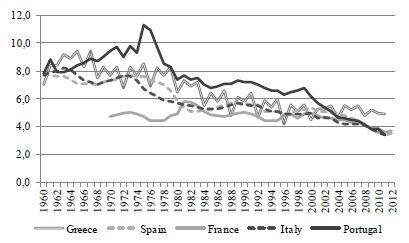
Figure 1 shows the decline of CMRs in five Mediterranean countries during the last fifty years. Until 2002, Portugal recorded the highest number of marriages concluded per 1,000 inhabitants on average, whereas in the last eight years of the period considered the highest CMR occurred in Greece.
The lowest average number of marriages per 1,000 persons was systematically displayed in France. Excluding Greece, there is a clear convergence of CMRs in the 2008-2012 period with an average number of marriages around 3.4 – 3.6.
Figure 1. Mediterranean countries. Crude Marriage Rates. Years 1960-2012.
Source: Eurostat. France: 1970-1993 OECD.
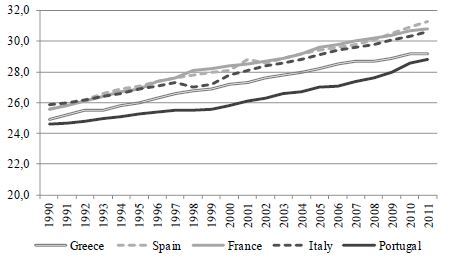
Undoubtedly interesting is the evolution of the age of women and men at first marriage. The general tendency points to marriage entries at an increasingly later age for both sexes. As illustrated in Figure 2, there is a clear growing trend of females’ mean age at first marriage in Mediterranean Europe in the period considered (1990-2011). The highest mean ages’ have been registered in France, systematically over 28 years old since 1998. However, female mean age at first marriage in France has been surpassed by the values registered in Spain during the last three years under observation (2009-2011) and it remains closer to Italian figures. In fact, the highest increase among these countries is registered in Spain. In Portugal, instead, women get married for the first time at younger ages: in 2000 was around 26 years old and, eleven years later, displayed a three years’ growth. At the end of the period mean ages at first marriage for women in Greece and Portugal tend to converge around 29 years old.
Figure 2. Mediterranean countries. Mean age at first marriage (females). Years 1990-2012.
Source: Eurostat.
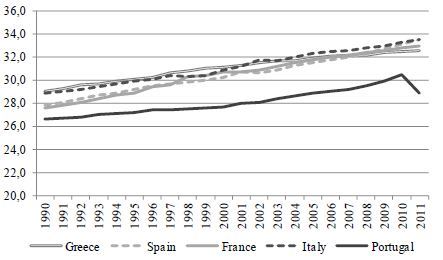
Figure 3. Mediterranean countries. Mean age at first marriage (males). Years 1990-2012.
Source: Eurostat.
Regarding males (Figure 3), there are four Mediterranean states where mean age at first marriage is over 32 since 2007. The eldest male first-timers live in France and Spain followed by Italy and Greece. Again, the youngest first-time grooms are Portuguese, who got married at 28.9 years old in 2011.
3. DIVORCE AND REMARRIAGE
Over the last decades the greatest autonomy to built the own life history in a more liquid society[xi] has support the emergence of alternative living arrangements by changing couples’ life course and the biographies of its protagonist. Also in Mediterranean Europe, union formation dynamics have been gradually modified, giving space to partnership-alternatives to marriage.
As stated previously, nuptiality models have changed profoundly since the end of the seventies thanks to a gradual decrease in the number of first marriages. However, the aspects that distinguish the most the current models are the postponement of first marriages and its increasing fragility. Divorce is not a new phenomenon in the history of European societies, but is remarkable its rapid spread in almost all Western countries. A process of universalization is at work, couples with or without children break-up and divorces no longer concerns only highly educated individuals but all socio-economic levels[xii].
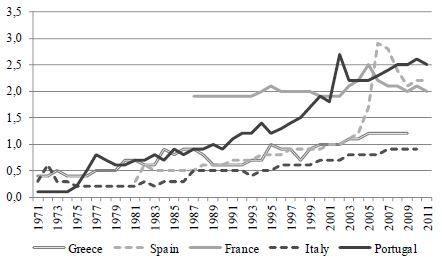
In most European countries the number of divorces is on the rise. The divorce rate is growing fast since the nineties in the Mediterranean (Figure 4), particularly in Spain where in 2006 the value reached 3 divorces per one thousand inhabitants the maximum reached in the area. In Italy, although the degree of marital instability is still significantly lower than the European average, the phenomenon of the marital disruption entered into a phase of accelerated growth at the end of the nineties, favoring an increase in the absolute number of divorces that has growth 100% between 1995 and 2008 (AISP 2011).
Figure 4. Mediterranean countries. Crude Divorce Rates. Years 1971-2011.
Source: Eurostat. France: 1987-1994 OECD.
The most relevant increase in Crude Divorce Rates has been registered in Portugal during the observed period. In fact, this country shows the highest rate of the area since 2008 (around 2.5) followed by Spain and France. Portugal is the Mediterranean country with the highest crude marriage rate and is also experiencing the highest crude divorce rate. In this country marriage and divorce are highly correlated.
The dissolution of marital unions affects family structures, which become more complex over time due to the emergence of single-parent and blended families. The dynamics of fertility are also influenced by these structural family changes, with a depressing effect on reproductive marriage projects related to family instability and a generalized positive effect of remarriages’ births[xiii].
One of the logical consequences of the increase of divorces is the raise of post-marital unions, especially of second marriages. Once marriage is dissolved, both ex-partners are free to establish a new union, thus high divorce rates are directly related to high rates of second marriages in countries were non marital unions are not so frequently practiced. Traditionally, remarriage have become more frequent among male population probably because the children from the previous union (if any) are generally reared by mothers[xiv].
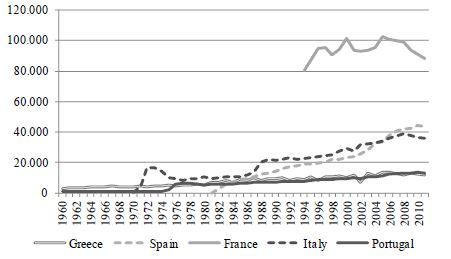
As shown in Figure 5, three differentiated trends regard the evolution of second marriages in Mediterranean Europe. The first is registered in France, where the number of second marriages is the highest observed and have oscillated between 80,000 and 110,000 in the period 1994-2010. The second trend shows an increase of second marriages since the end of the eighties in Spain and Italy. In these countries remarriage has been very similar until 2004, since then the highest number of second order marriages has been observed in Spain. The third trend is more stable and identifies both Portugal and Greece, where the number of second marriages remains the lowest celebrated in the Mediterranean.
Figure 5. Mediterranean countries. Number of marriages of divorcees. Years 1960-2011.
Source: Eurostat.
4. NON MARITAL BIRTHS
Also in Mediterranean Europe, union formation dynamics have been gradually modified, giving space to partnership-alternatives to marriage. Over the last fifty years cohabitation has gained importance with different tempo and levels all over Europe, becoming a new option for partnering. In the 1960s, cohabitation was rare in most European countries. Nowadays, cohabitation has become more popular, especially among the younger generations[xv]. Although a great heterogeneity characterizes both the extent and meaning of cohabitation among European countries[xvi].
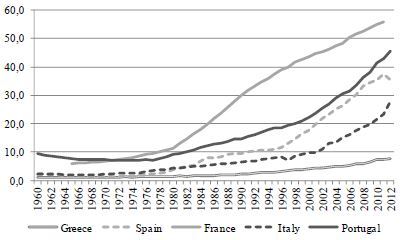
One of the proxies that confirm the spread of consensual unions is certainly the rise in the percentage of births occurred outside marriage (Figure 6). Until 1971, the highest proportion of extramarital births was recorded in Portugal (7-8%), which is classified in the second position with percentages lower than those registered in France during the rest of the period (1972-2012). In this country non marital births reached 50% of total births in 2005 and continued on the rise, the figure in 2012 was 56%.
In Spain the percentage of out-of-wedlock births born has increased progressively and intensely from 10% in the early nineties to 33.3% in 2010.
In the same period in Italy this indicator has also increased, but certainly at a slower pace, reaching 25.4%.
The different growth rates and the higher incidence of extra-marital births in France, Portugal and Spain could confirm a more widespread diffusion and a higher number of cohabitations in these countries if compared to Italy and Greece.
Figure 6. Mediterranean countries. Births outside marriage (%). Years 1960 -2012.
Source: Eurostat.
5. A HINT OF FAMILY POLICIES IN THE MEDITERRANEAN
The role of social policy, particularly those policies designed to aid and support families, marks important differences both in the social and political systems of the countries under study. On one hand, the rules of social values influence and affect markedly the decisions of the political systems, through the economic investment of the Welfare State; on the other, family policies influence and reinforce social norms[xvii] through the implementation of public actions that encourage behaviors conform to them.
However, family policies are the result of socio-economic circumstances that could affect an area, a region, but not necessarily the Country as a whole or, even, a wider geographical area. The attitude to generalize policy models has led many scholars, over the years, to identify a type or model of welfare, which generally holds some common characteristics and embraces Southern European Countries from the Mediterranean Basin (Italy, Greece, Spain and Portugal). Instead, France, even if geographically linked to the Mediterranean Area, has been traditionally closer to continental European patterns.
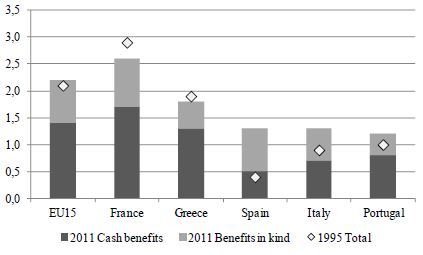
The differences between France and the other countries clearly emerge when we observe the State support to families in Mediterranean Europe, using public expenditure as a percentage of the Gross Domestic Product (Figure 7). The breakdown of public expending embraces both in-cash and in-kind benefits in 2011 and the total expenditure in 1995.
French family policies have been characterized by a strong support to birth regardless of whether it occurs inside or outside marriage. At 1939 (the same year was published the Family Code) in a Scientific Treat of great national importance, Boverat[xviii] illustrated the consequences of the strong birth decline in France, both at the financial and social levels. At that time the country had completed its process of demographic transition (earlier if compared to other European countries) and Boverat proposed, with very concrete measures, the creation of a "bonheur familiale" that would invest the entire society.
Figure 7. Mediterranean countries- EU15. Public expenditure on families (% GDP). Years 1995, 2011.
Source: Eurostat.
In the following years, France has always shown great ability in adopting ad hoc measures to secure the economic support of families, public services for the care of children and forms of parenting support. Therefore, support for families has always been experienced by French governments as a responsibility of the State and it resulted in a series of fiscal measures including investment in favor of families largely in place since 1948. Only in recent years (2012) family policies have changed, in particular with measures that have determined a gradual reduction of tax breaks dedicated to families.
This explains the performance of France in terms of public expenditure that ranks with higher values than the EU15 average (see Figure 7) and the pronounced distance from neighboring countries in Southern Europe.
Even though the distances that could be observed between France and other Mediterranean countries in terms of direct and indirect measures concerning support for families, could be also observed within national contexts: between northern and southern Italy and inside the Spanish Peninsula (for example Catalunya which aims to adopt policies more pro-European standard).
Concerning Spain, at the end of the nineties, some authors sharply criticized the Spanish family policy model considering it outdated because it did not take into account the new reality of the emerging family structures: the increase of single-parent families, the increase of divorces and remarriages (see Fig.5), the difficulties faced by mothers in finding a job, the incidence of child poverty and school failure[xix].
In subsequent years, something moved in Spain, and before the financial crisis, Spain went through a series of generous reform packages geared towards catching up with the social models of Northern and Central European countries. As was to be expected, however, the crisis has led to a deterioration of the economic well-being that has affected particularly the worst-off segments of society[xx].
The sore inside the family policies, in Italy, concerns particularly reconciliation policies (work-family), because projects concerning families are fragmented following a clear North-South separation. A turning point has arrived in 2009 with the "Plan for Italy 2020 for the inclusion of women in the labor market" followed by an Agreement in 2011 between Government and Social Partners aiming to introduce forms of flexibility and reconciliation of life and working time. As a consequence, Italian performance in OECD maternity leave ranking gets better, but it does not match with data on paternity leave where Italy does not even appear in the top twenty (contrary to what observed for France, Spain and even Greece).
In 2010 Italy public spending on family services, including cash transfers, spending on service delivery and tax breaks, is the 1.3% of GDP. In France it is around 3.02% and in the EU only Spain and Greece spend less than Italy. Furthermore analyzing the components of this expense, Italy devotes only 0.15% of GDP in direct interventions for very young children[xxi].
Looking last at Portugal, that inside the Southern European and Mediterranean model does not emerge a particular and well defined characterization, constitutes in April 2014 a Commission for a natalist policy in Portugal (Comissão para uma Política from Natalidade em Portugal). Where it is explained that public policies must recognize the signs and the needs of families; in particular there is a need for an integrated, universal and consistent family policy. A particular attention, perhaps for the first time (noting that “Portugal Amigo das Crianças, das Famílias e da Natalidade”) takes into account all the familiar realities and the needs they express. Step forward of the Portuguese Government with a long-term planning that spans two decades (2015-2035) which in France has been observed over seventy years before.
In sum, looking at all these disparities inside the Southern European Countries, we are convinced - as other authors proposed at the beginning of the century[xxii] - rather than trying to identify a pattern in which to fit the policies of southern Europe, which is expressed through measures specifically aimed at families, is preferable to analyze other features of the welfare state regime such as: income maintenance systems, labor market provisions and housing policies.
6. CONCLUSIONS
The measures considered by some databases offer a very comprehensive and interesting scenery on family policies in the countries of the OECD. However, some preliminary analysis, starting from the database of Gauthier[xxiii], have tried to correlate the data collected by the fertility rates of the individual countries, without finding any kind of positive correlation[xxiv]. The individual measures and their effects are difficult to assess, and can sometimes even lead to apparent paradoxes. More than direct policies to support family seems succeed indirect policies; actually, fertility is highest where stronger is the gender equality and higher are education and employment of women.
The political choices of the states of Southern Europe - except France - have not aimed to introduce universal systems of social protection, but rather to institutionalize segmented and residual social programs and welfare policies. In Southern European welfare capitalist regimes, the family acted as a decommodification agent when its members were out of the labour market or lacked the necessary resources to maintain their living standard.
The popular idea of the "Mediterranean model" based on widespread familism is outdated and we would like to bring counter argument. Is not the suppose familism that determines a laxity in family policies, but rather the opposite: it is the absence of policies for the family over the years’ that has fed in a "survival instinct" which later became a model.
The mean age at first child has risen and, consequently, the average age at first grandson (unfortunately there are few data on it); which suggests that the ‘Granpa State’ that aims to support their daughters, working mothers, is no longer sustainable.
It should be added that if Mediterranean women decide to leave their jobs for family responsibilities is not because they do not want to work or because they have a stronger sense of family compared to their peers in France or Northern Europe; otherwise we could not explain the high rates of women (30-34 years old) who have obtained a university degree, for example, in Southern Italy (equal to 21.7% compared to the Italian average of 26.3%, in 2012) that implicitly tell us that women have ambitions at work, that are blocked by an inexistent and inconsistent Welfare State.
Bibliography
AGOSTINO, Lucia, “Politiche familiari e fecondità: il Comparative Family Policy Database”, 2001, neodemos.it
ALMEIDA, Ana, ANDRÉ, LALANDA, Piedade, “Novos padrões e outros cenários para a fecundidad em Portugal”, Análisis Social, 37(163), 2003, pp. 371-410.
BESTEIRO GONZALES, Carlos, “La ridícula política familiar española”, Revista Universitaria de Ciencias del Trabajo España, VII, 1998, pp. 811-821.
BILLARI, Francesco,”Becoming an adult in Europe: a macro(/micro)-demographic perspective”, Demographic Research, 3(2), 2004, pp. 15–44.
BOVERAT, Fernand, Comment nous vaincrons la dénatalité. Par la vérité, par le devoir, par la justice, Paris, Éditions de l’Alliance nationale contre la dépopulation, 1939.
DE SANDRE, Paolo, ONGARO, Fausta, RETTAROLI, Rosella, SALVINI, Silvana, Matrimonio e figli: tra rinvio e rinuncia, Bologna, Il Mulino, 2007.
FLAQUER, Luis, “Family Policy and Welfare State in Southern Europe”, WP 185, Universitat Autonoma de Barcelona, Institut de Ciències Politiques i Socials, 2000.
GALASSO, Vincenzo, “I sistemi di Welfare in Europa e nel mondo”, Atlante geografico, 2012, Treccani.it.
GAUTHIER, Anne, 2011, Comparative Family Policy Database, Version 3 [computer file], Netherlands Interdisciplinary Demographic Institute and Max Planck Institute for Demographic Research (distributors). Retrieved from: www.demogr.mpg.de
GIDDENS, Antony, Modernity and self-identity: Self and society in the late modern age, Stanford, Stanford University Press, 1991.
GUERREIRO, Maria das Dores, ABRANTES, Pedro, “Transições incertas os jovens perante o trabalho ea família”, Lisboa, CIES, 2004.
HOULE, Rene, SIMÓ, Carles, SOLSONA, Montse, TREVIÑO, Rocío, “Análisis biográfico del divorcio en España”, Revista Española de Investigaciones Sociológicas, Vol. 88, 1999, pp. 11-35.
KIERNAN, Katherine, “The rise of cohabitation and childbearing outside of marriage in Western Europe”, International Journal of Law, Policy and the Family, 15(1), 2001, pp. 1-21.
KLÜSENER, Sebastian, NEELS, Karel, KREYENFELD, Michaela, “Family Policies and the Western European Fertility Divide, Population and Development Review, 39:4, 2013, pp. 587-610.
KOHLER, Hans-Peter, BILLARI, Francesco, ORTEGA, José Antonio, “The Emergence of Lowest-Low Fertility in Europe During the 1990s”, Population and Development Review, 28 (4), 2002, pp. 641-680.
MARÍ-KLOSE, Pau, MORENO-FUENTES, Francisco Javier, DEL PINO, Eloisa, “The Spanish social model in the crisis years”, Policy Network, 2014.
MARTIN, Claude, THÈRY, Iréne, “The Pacs and marriage and cohabitation in France", International Journal of Law, Policy and the Family, 15(1), 2001, pp. 135-158.
PRINZ, Christopher, Cohabiting, married or single: Portraying, analyzing and modeling new living arrangements in the changing societies of Europe. Brookfield, VT: Ashgate, 1995.
SIMÒ, Carles, SOLSONA, Montse, “Importancia de la participación laboral como determinante del divorcio en España”, Papeles de Geografía, n. 37, 2003, pp. 245-259.
SOBOTKA, Tomas, TOULEMON, Laurent, “Changing family and partnership behavior: common trend and persistent diversity across Europe”, Demographic Research, 19 (6), 2008, pp. 85-138.
TOBÍO, Constanza, “Marriage, cohabitation and the residential independence of young people in Spain”, International Journal of Law, Policy and the Family, n. 15, 2001, pp. 68-87.
[i] Katherine KIERNAN, ”The rise of cohabitation and childbearing outside of marriage in Western Europe”, International Journal of Law, Policy and the Family, 15(1), 2001, pp. 1-21.
[ii]Francesco BILLARI, ”Becoming an adult in Europe: a macro(/micro)-demographic perspective”, Demographic Research, 3(2), 2004, pp. 15–44.
[iii] Hans-Peter KOHLER, Francesco BILLARI, José Antonio ORTEGA, ”The Emergence of Lowest-Low Fertility in Europe During the 1990s”, Population and Development Review, 28 (4), 2002, pp. 641-680.
[iv] Claude MARTIN, Iréne THÈRY, "The Pacs and marriage and cohabitation in France", International Journal of Law, Policy and the Family, 15(1), 2001, pp. 135-158.
[v] Maria das Dores GUERREIRO, Pedro ABRANTES, Transições incertas os jovens perante o trabalho ea família, Lisboa, CIES, 2004.
[vi] Ana ALMEIDA, ANDRÉ, Piedade LALANDA, “Novos padrões e outros cenários para a fecundidad em Portugal”, Análisis Social, 37(163), 2003, pp. 371-410.
[vii] Constanza TOBÍO, ”Marriage, cohabitation and the residential independence of young people in Spain”, International Journal of Law, Policy and the Family, n. 15, 2001, pp. 68-87.
[viii] Hans-Peter KOHLER, Francesco BILLARI, José Antonio ORTEGA, ”The Emergence of Lowest-Low Fertility...cit.”.
[ix] Tomas SOBOTKA, Laurent TOULEMON, ”Changing family and partnership behavior: common trend and persistent diversity across Europe”, Demographic Research, 19 (6), 2008, pp. 85-138.
[x] Francesco BILLARI, ”Becoming an adult in Europe: a macro(/micro)-demographic...cit.”.
[xi] Antony GIDDENS, Modernity and self-identity: Self and society in the late modern age, Stanford, Stanford University Press, 1991.
[xii] Carles SIMÒ, Montse SOLSONA, ”Importancia de la participación laboral como determinante del divorcio en España”, Papeles de Geografía, n. 37, 2003, pp. 245-259.
[xiii] Paolo DE SANDRE, Fausta ONGARO, Rosella RETTAROLI, Silvana SALVINI, Matrimonio e figli: tra rinvio e rinuncia, Bologna, Il Mulino, 2007.
[xiv] Rene HOULE, Carles SIMÓ, Montse SOLSONA, Rocío TREVIÑO, "Análisis biográfico del divorcio en España", Revista Española de Investigaciones Sociológicas, Vol. 88, 1999, pp. 11-35.
[xv] Tomas SOBOTKA, Laurent TOULEMON, ”Changing family and partnership behavior..cit:”.
[xvi] Christopher PRINZ, Cohabiting, married or single: Portraying, analyzing and modeling new living arrangements in the changing societies of Europe. Brookfield, VT: Ashgate, 1995.
[xvii] Sebastian KLÜSENER, Karel NEELS, Michaela KREYENFELD, ”Family Policies and the Western European Fertility Divide, Population and Development Review, 39:4, 2013, pp. 587-610.
[xviii] Fernand BOVERAT, Comment nous vaincrons la dénatalité. Par la vérité, par le devoir, par la justice, Paris, Éditions de l’Alliance nationale contre la dépopulation, 1939.
[xix] Carlos BESTEIRO GONZALES, ”La ridícula política familiar española”, Revista Universitaria de Ciencias del Trabajo España, VII, 1998, pp. 811-821.
[xx] Pau MARÍ-KLOSE, Francisco Javier MORENO-FUENTES, Eloisa DEL PINO, ”The Spanish social model in the crisis years”, Policy Network, 2014.
[xxi] Vincenzo GALASSO, ”I sistemi di Welfare in Europa e nel mondo”, Atlante geografico, 2012, Treccani.it.
[xxii] Luis FLAQUER, ”Family Policy and Welfare State in Southern Europe”, WP 185, Universitat Autonoma de Barcelona, Institut de Ciències Politiques i Socials, 2000.
[xxiii] Anne GAUTHIER, 2011, Comparative Family Policy Database, Version 3 [computer file], Netherlands Interdisciplinary Demographic Institute and Max Planck Institute for Demographic Research (distributors). Retrieved from: www.demogr.mpg.de
[xxiv] AGOSTINO, Lucia, ”Politiche familiari e fecondità: il Comparative Family Policy Database”, 2001, neodemos.it